There’s nothing wrong with feeding someone you love. Eating, cooking, and sharing a meal can be an expression of culture, tenderness, and love. But what if you decide not to cook? What if you’re tired? What if you want to rest, read, work, sleep, or simply not be responsible for making dinner that day? Would you still be loved? Will you still be respected? Would you still be considered a good wife, good husband, partner, mother, father or daughter-in-law? Or do you cook at all?
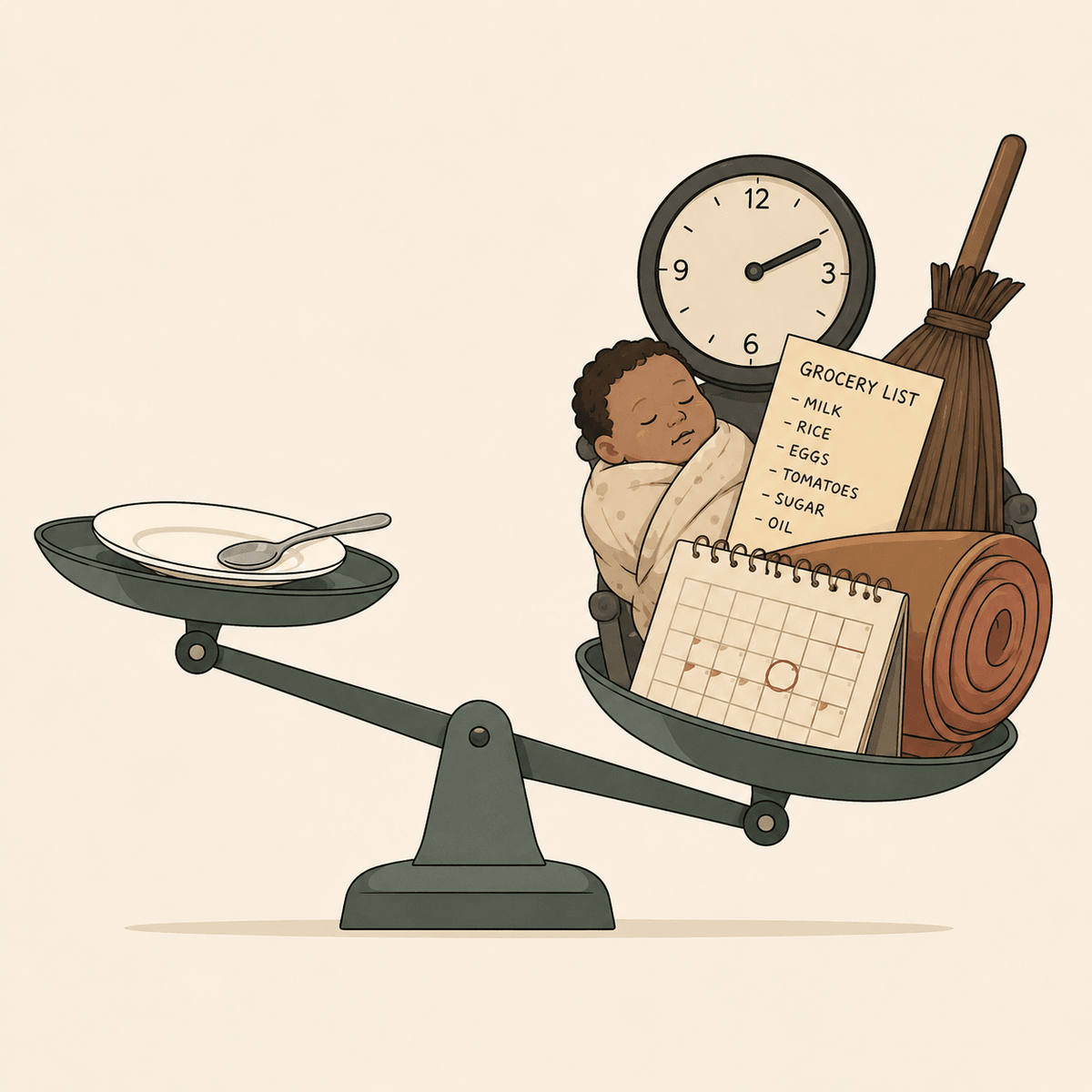
From the gender analyses I have led, supported, or reviewed and the programs I have implemented with small or large teams, they also confirmed that women are responsible for household chores, including cooking. This is old story. Women cook, serve, and feed the entire household, including children, husbands, and other male relatives, such as grandfathers. While cooking, women consider which ingredients are missing from the kitchen and plan the next meal before clearing away the current one. Sometimes they cook, but they are not responsible for going to the market. Even if they do go, they do not make any financial decisions. This dynamic varies depending on community, age, class, religion, tribe, country, etc. In some cases, such as with professional women, they have access to financial opportunities and can plan meals. However, most of them still have to cook because of their gender.
In my last essay, I wrote about the burden of fetching water and how it consumes women’s time. Cooking is one of those tasks. Although my focus was on women living in drylands, time poverty remains one of the most underestimated gender issues and it affects more women than you think. While gender issues are addressed through empowerment programs, women’s leadership, and sometimes men’s involvement, we still do not pay enough attention to the hours women lose before the day has even properly started.
How much attention should we pay to unpaid work?
In my experience, the most revealing gender-related questions often arise during pauses: between training sessions, in the hallway, and—the most fun—under a tree while people wait for lunch. Those are the moments when the real questions arise. I loved those moments. Why? In my experience, this is where you get the full story, if you are willing to listen with your heart. Gender equality doesn’t happen overnight, but rather starting the day by understanding and negotiating small steps. Sometimes, even when there is no common ground, we can still agree to move forward and be patient. We can’t change people, but we can help them decide what they want to change if they are willing. The best way is to see the consequences of a behavior. I don’t intend to soften gender issues, but I’m being realistic about what we can promise in training and the level of commitment we’re willing to make. One step at a time, right?
Let’s see the most fun place, under the tree. During that conversation, a man might say, “I understand gender issues are real, but my wife is responsible for cooking. Why should I bother? She cooks well, and I love her cooking.” Another might say, “I can’t cook. If I try, my in-laws will laugh at me.” Or a woman can say, “ I love cooking and I love feeding my family and I don’ t see where the problem is with that’’. Guess what? I love cooking too and the real problem isn’ t there. The real question is ‘’ who is allowed to cook without shame and who is expected to cook without complaint.
I am aware that the gender issues surrounding the plate might be controversial. Hold on.
During one field assignment, I arrived in a community where the team was excited. They told me that they had seen several men carrying babies. They were almost relieved and shared the “good news” with me as soon as I put down my travel bag and had lunch with them that day. You could see in their eyes that they were happy about the real changes they had seen in the community. The main problem was that they compared this behavior to that of another community where men rarely participated in childcare. Some even suggested that perhaps there weren’t many gender issues to examine there. I understood their excitement. It’s good to see, right? A man carrying his baby can signal care and, most importantly, challenge the narrow idea that fatherhood is only financial provision. But where are the women? What are they doing? Why were so many men out there carrying their babies and sitting in the courtyard? I asked myself. Later, in the gender analysis, I understood that men carried their babies because women had to travel far from home to fetch water or sell goods at markets up to 20 kilometers away. They would return late at night. At this time, they start cooking. A lot, right?
Cooking doesn’t always show love. Sometimes it’s an invisible burden that steals joy and even life.
Plates tell more stories than you can imagine. For example, think about how a plate ends up on your table. Next time, you might ask yourself these questions: Is it out of obligation based on the gender of the cook? Or is it because of social norms? Or is it because you want to share love and receive love in return? Are there any sacrifices made to have that food? How should we go about it? The most important thing about good food is sharing it with the people we love. Not the other way around.
Why should we bother?
Globally, women and girls spend far more time on cooking than men do. According to UN Women, women and girls spend more than 2.5 times as many hours per day on unpaid care work as men do. The KNBS in Kenya (see Table 1) reports that women spent 14,673.6 million hours on nutrition services, compared with 2,157.5 million hours for men. The KNBS also valued the total amount of unpaid domestic and care work at approximately KSh 2.423 trillion per year, about 23.1% of Kenya’s 2021 GDP.
Table 1: Volume of Hours of Unpaid Domestic and Care Work by Broad Category and Sex, 2021
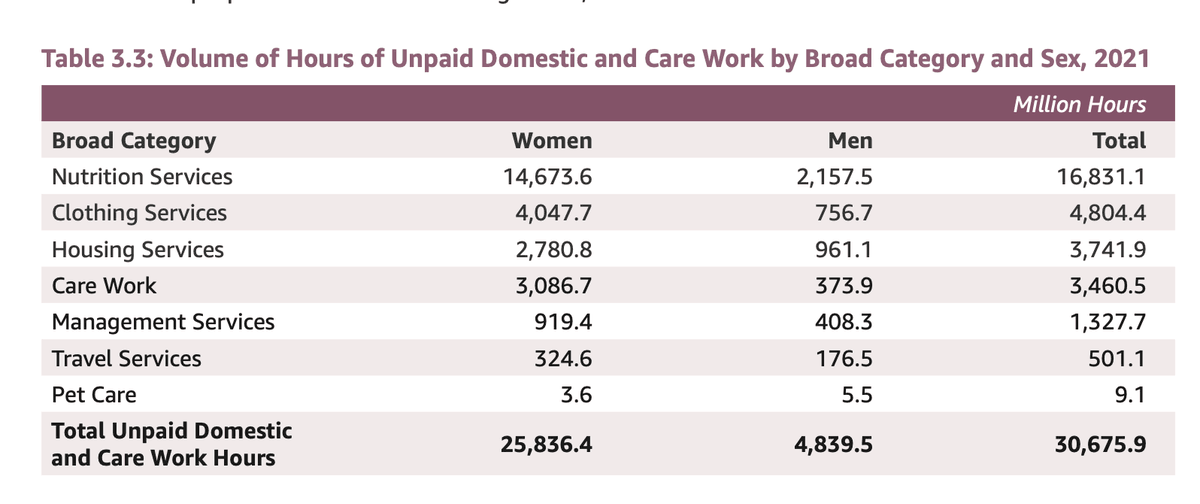
Source: Kenya National Bureau of Statistics, Economic Value of Unpaid Domestic and Care Work in Kenya 2025, 25.
ILOSTAT estimates that if women’s unpaid work were given a monetary value, it would exceed 40 percent of GDP in some countries — more than entire sectors such as manufacturing or transportation. UN Women confirmed that this essential labor remains largely invisible in national statistics and budgets. This invisibility is one of the biggest drivers of poverty and inequality worldwide, with lifelong consequences for women.
I don’t think women simply “choose” domestic service; this is far beyond what we feel normal and it is the social norms that shape what is expected or considered disrespectful. A UNICEF review points out that gender norms surrounding unpaid work begin early in the home. The review notes that girls aged 5–14 spend 160 million more hours every day on unpaid care and domestic work than boys of the same age. The ODI/ALIGN study further links breadwinner/caregiver norms to women’s labor-market exclusion. For example, Oxfam’s WE-Care program in Ethiopia, Kenya, Tanzania, Uganda, and Zimbabwe frames unpaid care and domestic work as a major driver of gender inequality in Africa which confirms the UN women statement.
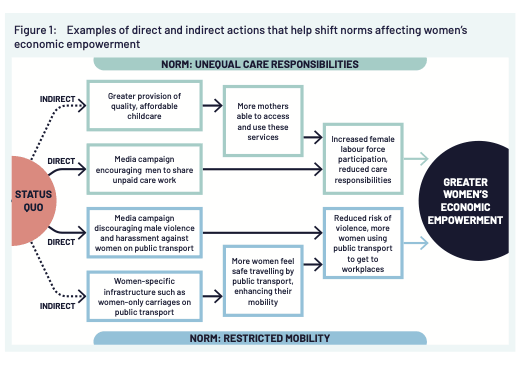
Source: Marcus and Somji, Transforming Gender Norms for Women’s Economic Rights and Empowerment: Executive Summary, 4.
I might mention these questions millions of times in linkedin posts, in training or any conversation I would have on unpaid work. Who cooks? Who decides? Who controls the money? Who gets to rest? Who is served first? Who is allowed to be tired? Who can refuse without conflict? Think about it and get ready to be surprised. Or if you are not, let that stay with you for a moment and see if the answers can help you have another perspective on unpaid care.
There would be more evidence on a research paper. Beyond evidence there is no single solution that will miraculously change everything and tomorrow when we wake up, everything changes. I’d doubt that. There is nothing wrong with cooking, feeding and eating with your loved one, but do you have a choice?
About choices... There is so much confusion about choice. When we go by design and what we see every day, we think we have chosen something, but it’s only because of what is around us. It’s no secret that social media affects our daily choices. Deep down, we want something else, but we are afraid of how society might perceive us, so we “behave.” It’s safer. This is why, particularly with regard to gender equality, we as a society must make collective decisions to support men and women who want to share household chores without feeling like someone is out there laughing at them for choosing to do so. All right, we’re in 2026. Should we talk about this again? You might be surprised by how many conversations have happened about sharing responsibility. My friend, we’re are not there yet; And, there’s a real cost behind not to talk about it.
Why don’t we start with small steps? I propose five.
- Let’s learn and unlearn: I am also practicing this. For instance, I used to think that the only serious way to stay active was to go to the gym. This idea stemmed from what I saw around me: social media, wellness culture, societal expectations of the body, and the pressure to demonstrate discipline publicly. However, movement can also be walking, dancing or simply doing whatever works for your body and life. Unlearning begins when we ask, “Who taught me this, and who benefits when I continue believing it?”
- Let’s rethink partnerships within the household. The household structure is a system that shows power levels, roles, and responsibilities, to which we tend to cling. Even if it’s the right move, the status quo keeps us in the dark, and we can’t see or explore the best ways to create partnerships. I am talking about a real partnership, if you know what I mean.
- Let’s create safe spaces for men who care: It’s a small (negative) comment about men who care, that creates a vicious circle. It reinforces the burden of care for women and prevents good practices from being adopted. If a man cooks, cleans, fetches water, cares for a child, or supports his partner at home, society should not view that as a sign of weakness. I see it more like adulthood and care enough to share the responsibility among the families/household.
- Let’s make the invisible visible: Household work seems insignificant because it is repeated every day. But it is precisely this repetition that makes it important. Cooking once may seem simple. But cooking every day, planning every meal, tracking what’s missing, serving others, cleaning up after them, and doing it all again tomorrow, is not small. There is a name for it. Labour.
- Let’s move from “helping” to shared responsibility. The language of “helping” keeps power in the wrong place. I really think it will keep us in the dark. Helping suggests that the work belongs to women, and that men are being generous when they participate. So, instead of saying “my partner helps me” or “I help my partner,” What if both people carry the household as a shared responsibility?
I know these aren’t miraculous solutions. This is an invitation to think more intentionally about care, starting in your own home. Ask yourself: What does cooking cost you? Who benefits from it? What would the system look like if it were built differently?
Further Reading
Kenya National Bureau of Statistics. (2025). Economic value of unpaid domestic and care work in Kenya. https://www.knbs.or.ke/reports/economic-value-of-unpaid-domestic-and-care-work-in-kenya-2025/
UN Women. (2020). Whose time to care: Unpaid care and domestic work during COVID-19.
https://data.unwomen.org/publications/whose-time-care-unpaid-care-and-domestic-work-during-covid-19
Oxfam International. (2020). Time to care: Unpaid and underpaid care work and the global inequality crisis.https://policy-practice.oxfam.org/resources/time-to-care-unpaid-and-underpaid-care-work-and-the-global-inequality-crisis-620928/
ILO. (2018). Care work and care jobs for the future of decent work.
https://www.ilo.org/publications/major-publications/care-work-and-care-jobs-future-decent-work
ActionAid International. (2013). Making care visible: Women’s unpaid care work in Nepal, Nigeria, Uganda and Kenya.https://actionaid.org/publications/2013/making-care-visible
Marcus, R., & Somji, A. (n.d.). Transforming gender norms for women’s economic rights and empowerment.ODI/ALiGN.
Cislaghi, B., & Heise, L. (2019). Using social norms theory for health promotion in low-income countries. Health Promotion International, 34(3), 616623. https://pubmed.ncbi.nlm.nih.gov/29579194/
Elson, D. (2017). Recognize, reduce, and redistribute unpaid care work: How to close the gender gap. New Labor Forum, 26(2), 52–61.https://newlaborforum.cuny.edu/2017/03/03/recognize-reduce-redistribute-unpaid-care-work-how-to-close-the-gender-gap/
Longwe, S. H. (1991). Gender awareness: The missing element in the Third World development project. In T. Wallace & C. March (Eds.), Changing perceptions: Writings on gender and development. Oxfam. (Available via Oxfam library and academic repositories.)